持仓列表变长了,风险未必就充分分散。除了数一数买了几只,还要看看:这些投资会不会被同一件事同时影响?
一、公司不同,共同风险仍可能存在
持有多家公司的股票,可以减少对某一家公司的依赖。不过,同一行业的公司可能共同受到需求、成本或政策变化影响。如果资金主要放在这些公司里,行业风险仍可能集中。FINRA的投资者教育资料也提醒,同一行业、地区或证券类型的投资,表现可能有较强关联。
二、用一个虚构案例看清楚
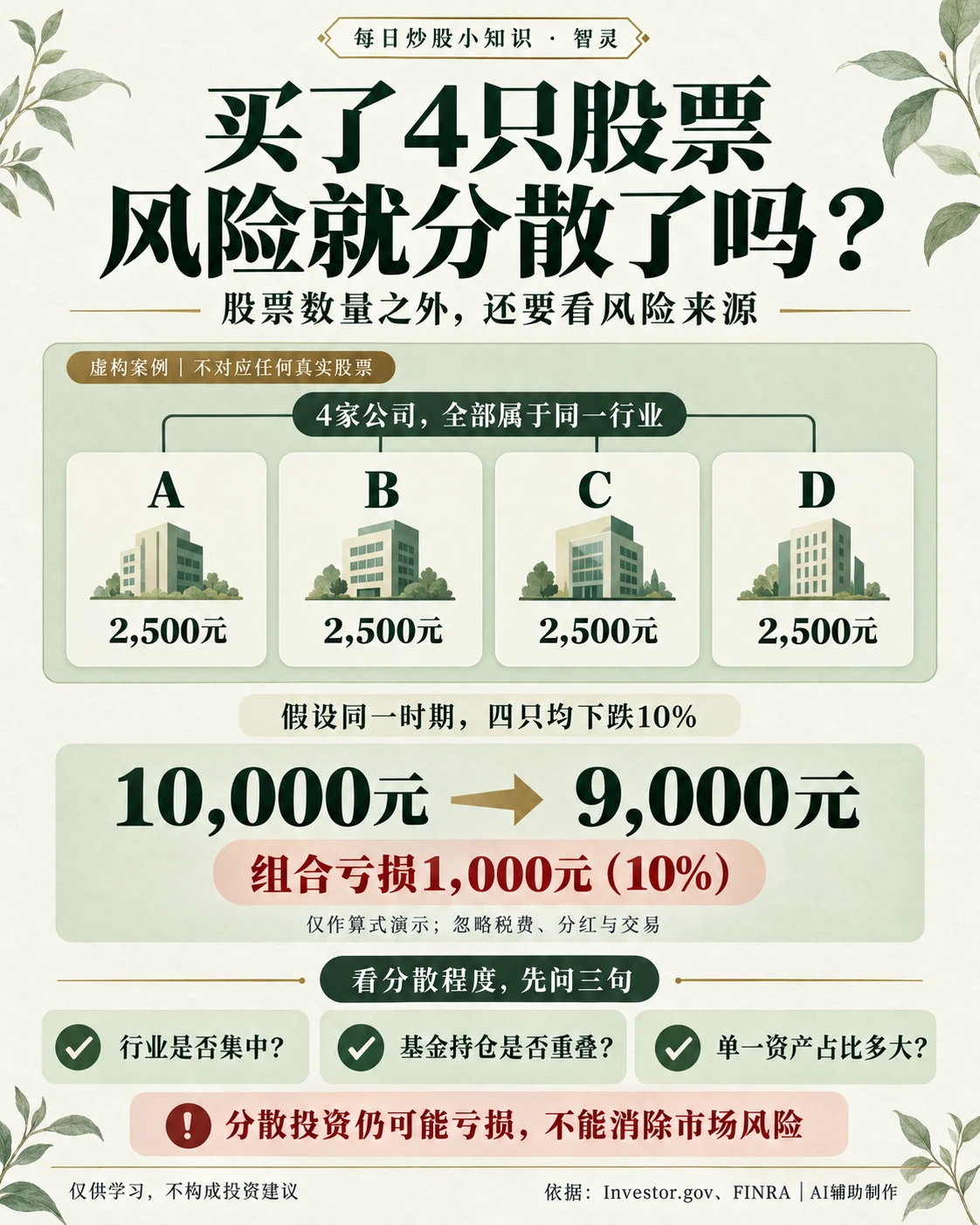
假设一个模拟组合共有10,000元,全部持有同一虚构行业的4家公司股票:
- A:2,500元
- B:2,500元
- C:2,500元
- D:2,500元
四只各占25%,这个行业合计仍占100%。
再假设同一时期,四只股票都下跌10%,期间没有交易,忽略税费和分红:
每只剩余金额=2,500×(1-10%)=2,250元
组合剩余金额=2,250×4=9,000元
组合亏损=10,000-9,000=1,000元
组合跌幅=1,000÷10,000=10%
这是为了说明共同风险而设定的算式,并不表示同一行业的股票总会同涨同跌,也不是对任何行情的预测。它提醒我们:即使分成了4只股票,资金依然可能集中在同一行业。
三、看分散程度,先问三句
- 行业是否集中?把持仓按行业合在一起看,关注各行业占了多少资金。
- 基金持仓是否重叠?几只基金可能买了很多相同的股票,也可能都集中在同一行业。可以查看它们最新披露的投资范围和持仓。
- 单一资产占比多大?除了持仓数量,还要看某一只股票、某个行业或某类资产,在整个组合里占了多少资金。
Investor.gov提醒,基金或ETF也不一定足够分散,尤其是范围狭窄的行业产品;持有多只基金时,还应核对它们的主要持仓是否重叠。
参考:美国证监会Investor.gov《资产配置与分散投资》
四、分散投资也有边界
分散可以帮助管理风险,但不能消除市场风险,也不能保证盈利。市场普遍下跌时,分散后的组合仍可能亏损。具体配置还要结合投资期限和承受损失的能力,不能只靠“买够几只”来判断。
记住一句:看清资金背后的共同风险,才能理解分散的意义。
本文与配图由AI辅助制作。案例完全虚构,不对应任何真实股票或个人账户,仅供学习交流,不构成个股推荐或投资建议。市场有风险,投资需谨慎。
English version
Does Buying 4 Stocks Mean Your Risk Is Diversified?
A longer list of holdings does not necessarily mean your risk is sufficiently diversified. As well as counting how many investments you own, ask: could the same event affect these investments at the same time?
1. Different Companies Can Still Share Common Risks
Holding shares in several companies can reduce your dependence on any one company. However, companies in the same industry may all be affected by changes in demand, costs, or policy. If most of your money is invested in these companies, your industry risk may still be concentrated. FINRA’s investor education materials also note that investments in the same industry, region, or type of security may have strongly correlated performance.
Reference: FINRA, “Concentration Risk”
2. A Fictional Example Makes This Clear
Suppose a simulated portfolio totals 10,000 yuan, invested entirely in shares of 4 companies in the same fictional industry:
- A: 2,500 yuan
- B: 2,500 yuan
- C: 2,500 yuan
- D: 2,500 yuan
Each of the four stocks accounts for 25%, but the industry still accounts for 100% in total.
Now suppose all four stocks fall by 10% over the same period, with no trading during that time, ignoring taxes, fees, and dividends:
Value remaining in each stock = 2,500 × (1 − 10%) = 2,250 yuan
Value remaining in the portfolio = 2,250 × 4 = 9,000 yuan
Portfolio loss = 10,000 − 9,000 = 1,000 yuan
Percentage decline in the portfolio = 1,000 ÷ 10,000 = 10%
This calculation is constructed to illustrate common risks. It does not mean that stocks in the same industry always rise and fall together, nor is it a forecast of any market movement. It reminds us that even when money is divided among 4 stocks, it can still be concentrated in the same industry.
Illustration: A fictional example with 2,500 yuan invested in each of four companies, A, B, C, and D, in the same industry. Assuming all fall by 10% over the same period, the portfolio falls from 10,000 yuan to 9,000 yuan, a loss of 1,000 yuan. Beyond the number of holdings, check industry concentration, overlapping fund holdings, and asset weights. Diversified investments can still lose money.
3. Start with Three Questions When Assessing Diversification
- Are your holdings concentrated in particular industries? Group your holdings by industry and look at how much money is allocated to each.
- Do your funds’ holdings overlap? Several funds may hold many of the same stocks, or they may all be concentrated in the same industry. You can review their most recently disclosed investment scope and holdings.
- How much is allocated to a single asset? Beyond the number of holdings, look at how much of the entire portfolio is invested in one stock, one industry, or one asset class.
Investor.gov notes that a fund or ETF is not necessarily sufficiently diversified, particularly a narrowly focused industry product. When holding several funds, you should also check whether their largest holdings overlap.
4. Diversification Has Its Limits
Diversification can help manage risk, but it cannot eliminate market risk or guarantee a profit. When the market falls broadly, a diversified portfolio can still lose money. Your specific allocation also needs to reflect your investment horizon and ability to bear losses; you cannot judge it simply by whether you have bought “enough” stocks.
Reference: U.S. Securities and Exchange Commission’s Investor.gov, “Diversify Your Investments”
Remember: understanding the common risks behind your investments is essential to understanding what diversification means.
This article and its illustration were created with AI assistance. The example is entirely fictional and does not represent any real stock or personal account. It is for learning and discussion only and does not constitute a recommendation of any individual stock or investment advice. Markets involve risk; invest with caution.