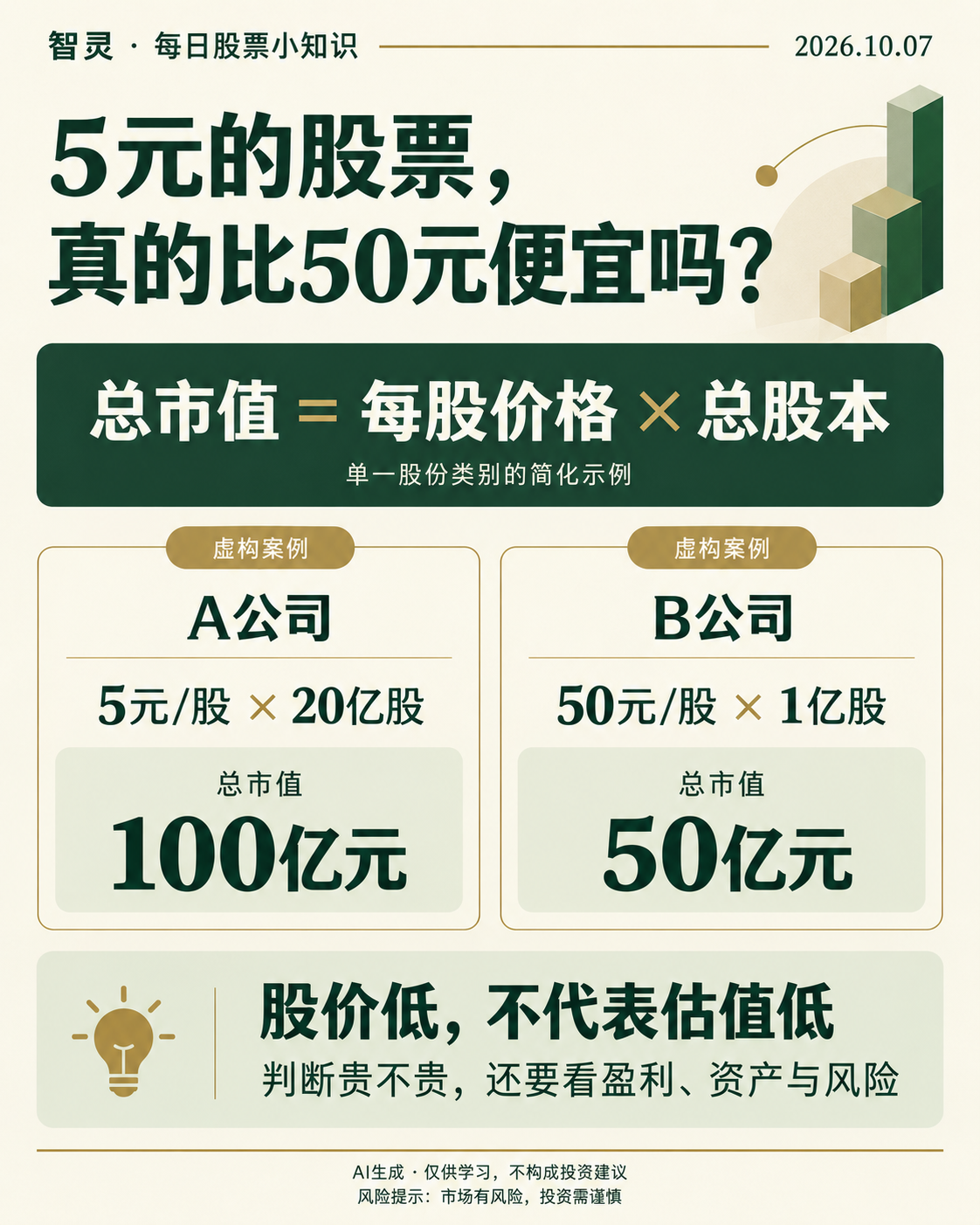
看到一只股票5元,另一只50元,很容易觉得前者“便宜”。但这个数字只告诉你买一股要多少钱。每家公司分成的股份数量不同,单看每股价格,无法判断它的股票是否被低估。
先认识总市值。对只有一种股份类别的简化公司,可以这样算:
总市值=每股价格×总股本。
它描述按当前股价计算的全部股份的市场价值,不能直接当作公司的净资产,也不代表已经算出了合理价值。市值定义:美国证监会Investor.gov
虚构案例,仅作算式演示:
A公司:5元/股×20亿股=100亿元。
B公司:50元/股×1亿股=50亿元。
A的每股价格只有B的十分之一,总市值却是B的两倍,原因是A的股份数量更多。这个例子说明,比较单股价格时,不能忽略背后的股份数量;但也不能据此认定A贵、B便宜。
实际看股票时,可以先问三句:总股本是多少?对应的总市值是多少?这样的价格,相对于盈利、资产、负债和未来经营风险,是否合理?这些信息可以从公司披露的财务报告和风险说明中继续了解。若公司有不同类别或不同市场挂牌的股份,还要核对市值的计算口径。财报阅读依据:美国证监会入门指南
记住一句:股价低,不代表估值低;判断“贵不贵”,还要看价格背后的公司。
本文与配图由AI辅助制作。案例为虚构,不对应任何股票,仅供学习,不构成个股推荐或投资建议。市场有风险,投资需谨慎。
English version
Is a 5-Yuan Stock Really Cheaper Than a 50-Yuan Stock?
Illustration: Is a 5-yuan stock really cheaper than a 50-yuan stock? Total market capitalization equals the price per share multiplied by the total number of shares. Fictional example: Company A has a share price of 5 yuan multiplied by 2 billion shares, giving a market capitalization of 10 billion yuan; Company B has a share price of 50 yuan multiplied by 100 million shares, giving a market capitalization of 5 billion yuan. A low share price does not mean a low valuation.
When you see one stock priced at 5 yuan and another at 50 yuan, it is easy to think the first is “cheap.” But that number tells you only how much it costs to buy one share. Different companies are divided into different numbers of shares, so the price per share alone cannot tell you whether a stock is undervalued.
Start by understanding total market capitalization. For a simplified company with only one class of shares, it can be calculated as follows:
Total market capitalization = Price per share × Total number of shares.
This describes the market value of all the shares at the current share price. It cannot simply be treated as the company’s net assets, nor does it mean you have determined its fair value. Definition of market capitalization: U.S. Securities and Exchange Commission’s Investor.gov
A fictional example, solely to illustrate the calculation:
Company A: 5 yuan per share × 2 billion shares = 10 billion yuan.
Company B: 50 yuan per share × 100 million shares = 5 billion yuan.
A’s share price is only one-tenth of B’s, yet its total market capitalization is twice B’s because A has more shares. This example shows that when comparing prices per share, you cannot ignore the number of shares behind them. But it does not establish that A is expensive or B is cheap.
When looking at a stock in practice, start with three questions: How many shares are there in total? What is the corresponding total market capitalization? Is that price reasonable in relation to earnings, assets, liabilities, and future business risks? You can explore these questions further in the company’s published financial reports and risk disclosures. If a company has different share classes or shares listed in different markets, you also need to check the basis on which market capitalization is calculated. Financial statement reading reference: The U.S. Securities and Exchange Commission’s beginner’s guide
Remember: a low share price does not mean a low valuation. To judge whether a stock is “expensive,” you also need to look at the company behind the price.
This article and its illustration were created with AI assistance. The example is fictional and does not represent any stock. It is for learning only and does not constitute a recommendation of any individual stock or investment advice. Markets involve risk; invest with caution.